
Medical Management & Treatment

UNDERSTANDING
SMS
PRISMS Professional Advisory Board has created a set of Medical Management Guidelines and associated Checklist for Smith-Magenis Syndrome to best inform families and the physicians who serve them on evaluations to be conducted following initial SMS diagnosis, treatment of manifestations, and ongoing surveillance of the syndrome.
Variability among individuals and developmental changes are important to recognize. These guidelines were developed and approved by the PRISMS Professional Advisory Board. First published as part of the in-depth review of SMS that appears in GeneReviews (last updated September 2019), these guidelines were updated and approved by the PRISMS Professional Advisory Board in January 2018. The terminology used here that is USA-focused may be adapted, as appropriate, for use in other countries.
Download the Medical Management Guidelines and Checklist (PDF files) by clicking on the buttons below.

Birt-Hogg-Dubé Syndrome
BHD & SMS
Birt-Hogg-Dubé Syndrome (BHD) is an adult-onset medical condition characterized by symptoms involving the skin, lungs, and kidneys. It is a rare genetic disorder caused by changes in a single gene called folliculin (FLCN). FLCN happens to be located within the 17p11.2 chromosomal region that is deleted in most people with SMS. Although most adults with SMS do not develop BHD, it is important for families and professionals to be aware of the connection between these two separate disorders.
In addition to what is in our Medical Management Guidelines, our Professional Advisory Board has put together a short guide on what we currently know about BHD.
Constipation
CONSTIPATION & SMS
Constipation is a common concern reported by caregivers of individuals with special health care needs, such as Smith-Magenis Syndrome (SMS). Smith and colleagues identified constipation as a frequent medical symptom observed among 53% of study participants.
The rate of constipation in SMS is higher than median rates found in neuro-typical children (up to 30% worldwide), adults (up to 16%), and adults older than 60 years (33%). The frequency of constipation among individuals with intellectual disability (ID) varies depending on how the studies were conducted, with most in the range of 33% to 50%.


Become a Supporter
PRISMS is honored to offer this invaluable resource FREE of charge to you, your family, and the medical community who serves you. If you feel supported and inspired by PRISMS work, consider making a contribution to fund future updates of this resource and the creation of additional guides.
Living with SMS

BEHAVIOR

SPEECH & LANGUAGE

SLEEP

MEDICAL MANAGEMENT & TREATMENT

MEDICATION

GUARDIANSHIP & FINANCIAL PLANNING
Birt-Hogg-Dubé Syndrome
BIRT-HOGG-DUBÉ AND SMITH-MAGENIS SYNDROME: SEPARATE DISORDERS LINKED THROUGH 17P11.2
Thank you to the PRISMS Professional Advisory Board for putting together this FAQ; to Laura S. Schmidt, Ph.D. at the National Cancer Institute for her expertise and additional review; and to SMS parent Jill Effron for championing this effort.
What is Birt-Hogg-Dubé syndrome and how is it related to SMS?
Birt-Hogg-Dubé syndrome (BHD) is an adult-onset medical condition characterized by symptoms involving the skin, lungs, and kidneys. It is a rare genetic disorder caused by changes (mutations) in a single gene called folliculin (FLCN). FLCN happens to be located within the 17p11.2 chromosomal region that is deleted in most people with SMS. Although most adults with SMS do not develop BHD, it is important for families and professionals to be aware of the connection between these two separate disorders.
What are the symptoms of BHD and when do they occur?
The primary symptoms of BHD involve the skin, lungs, and kidneys. The estimated rates of occurrence for each symptom and ages of onset are based on studies of individuals and families diagnosed with BHD. Since these studies did not include people with SMS, the actual risk of BHD symptoms in individuals with SMS is unknown but may be significantly lower than described in families with FLCN mutations.
SKIN:
Small dome-shaped bumps (known as fibrofolliculomas, also trichodiscomas) appear on the face, neck, and upper body in most adults diagnosed with BHD over the age of 25. These skin changes are generally not dangerous to one’s health but may create cosmetic concerns. Fibrofolliculomas must be confirmed by biopsy, as skin tags and bumps are common in the general population and are usually not related to BHD.
LUNGS:
Most people with BHD develop cysts in their lungs after age 30. By themselves, these cysts rarely cause noticeable symptoms. However, these cysts are associated with an increased risk for a more serious condition called spontaneous pneumothorax (also known as collapsed lung). By age 40, about 30% of adults with BHD will have had one or more episodes of pneumothorax. Onset is typically in adulthood but can occasionally occur in children. Pneumothorax is a painful and potentially serious condition that requires urgent medical treatment.
KIDNEYS:
Up to one third of older adults with BHD develop kidney cancer (renal cell carcinoma), usually in their late 40s to early 50s, but occasionally in young adulthood. The type of kidney cancer that develops most often in BHD patients tends to be less aggressive and less likely to spread throughout the body (metastasize) than other types of kidney cancer, so there are fewer reported cases of cancer-related deaths among BHD patients than in other types of kidney cancer. Individuals diagnosed with BHD require routine MRI scans of the abdomen to check for signs of cancer so that treatment can be started early.
How do mutations in FLCN cause BHD, and are adults with SMS at risk?
Scientists believe that BHD occurs due to a “two-hit” process. Most individuals diagnosed with BHD are born with a mutation in the genetic code of one copy of their two FLCN genes. This first mutation is present in every cell in the body, but by itself is not enough to cause the clinical symptoms of BHD. However, over the course of a person’s lifetime, a random change in one or more cells in a person’s second copy of FLCN (a second hit) can trigger BHD. This second mutation typically occurs in lung, skin, or kidney cells, resulting in the features of the disorder. Those in whom a second mutation occurs will be more likely to develop BHD manifestations, whereas other people born with one FLCN mutation may never develop a second mutation and will not develop BHD. However, the risk to develop a second mutation is a lifetime risk.
FLCN is one of dozens of genes located within the 17p11.2 chromosomal region. Most people with SMS are born with a 17p11.2 deletion that includes FLCN. As with mutations, one deleted copy of FLCN is not enough to cause BHD clinical symptoms. However, as they age, adults with SMS are theoretically at risk for developing BHD if the copy of FLCN on their non-deleted chromosome 17 happens to randomly undergo a mutation in some of their cells. In other words, because of their 17p11.2 deletion, most people with SMS are born with a first hit, putting them at risk for developing BHD if the FLCN gene on their non-deleted chromosome 17 receives a second hit.
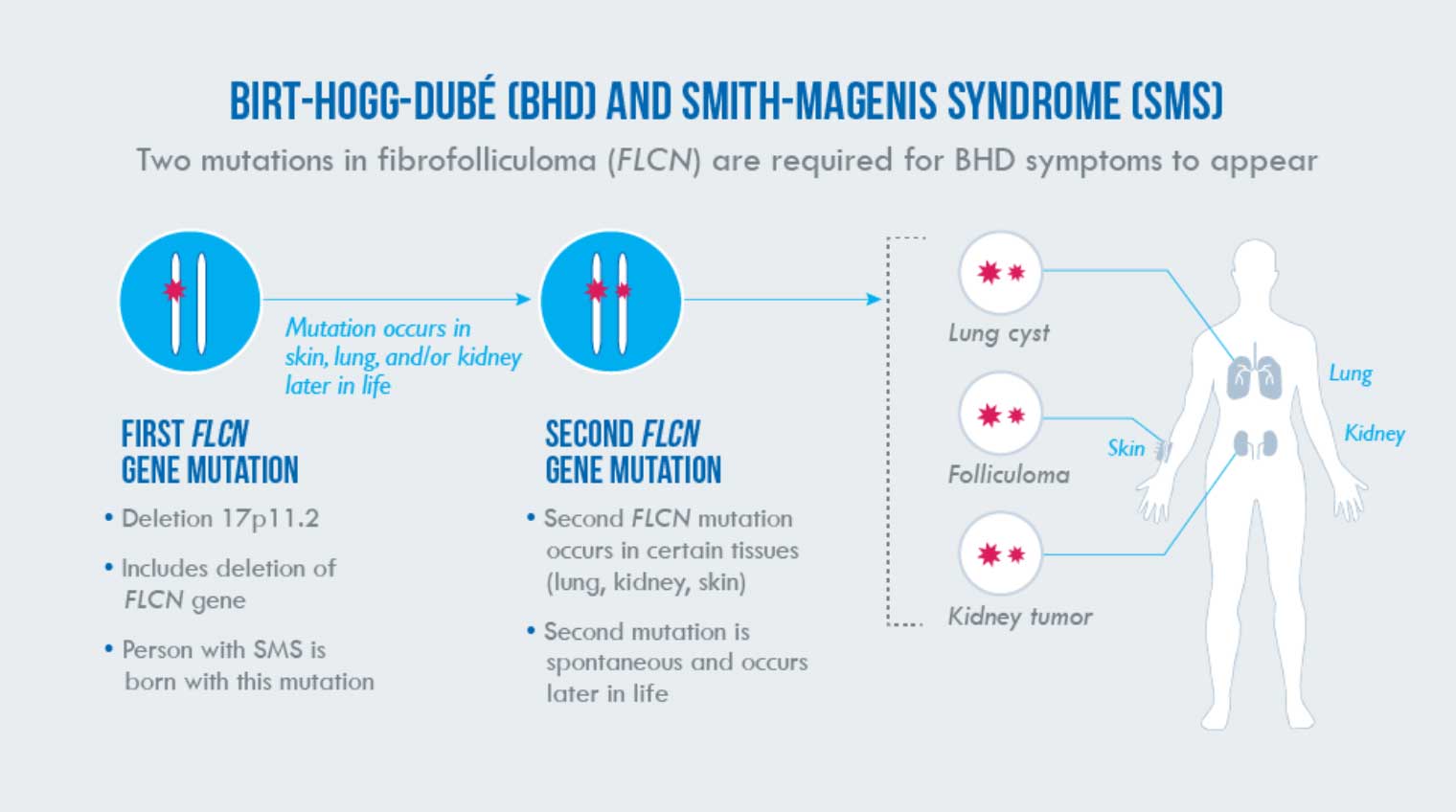
Figure illustrating the current understanding of the two-hit hypothesis in relation to SMS and BHD. Please note that while current research suggests the second hit is required for development of kidney tumors, studies have suggested that mutation of one copy of the FLCN gene may be sufficient to trigger the development of lung cysts and fibrofolliculomas. See van Steensel et al., 2007 and Koga et al., 2009 for more information.
Individuals with SMS due to RAI1 mutations and those with uncommon deletions that do not include the FLCN gene are at no greater risk than the general population for developing BHD. There has been theoretical concern for increased renal cancer risk in patients with SMS since the majority of SMS cases result from a 3.7 Mb deletion in 17p11.2, which includes the FLCN gene. In 2014, Ann C. M. Smith and her colleagues at the NIH described two adults with SMS (50-year-old woman & 45-year-old man) with kidney cancer; they have since identified two additional unrelated adults with SMS and co-occurrence of BHD features leading to their recent publication (Vocke et al., 2023). Among these four cases, three constitute the first known association of histopathologically verified characteristic BHD-associated renal tumors in adults with SMS; the fourth was identified to have histologically confirmed skin fibrofolliculomas.